Solar Panel Types Explained: Monocrystalline, Polycrystalline, and Bifacial
Published: March 2026 | Category: Technical Guide
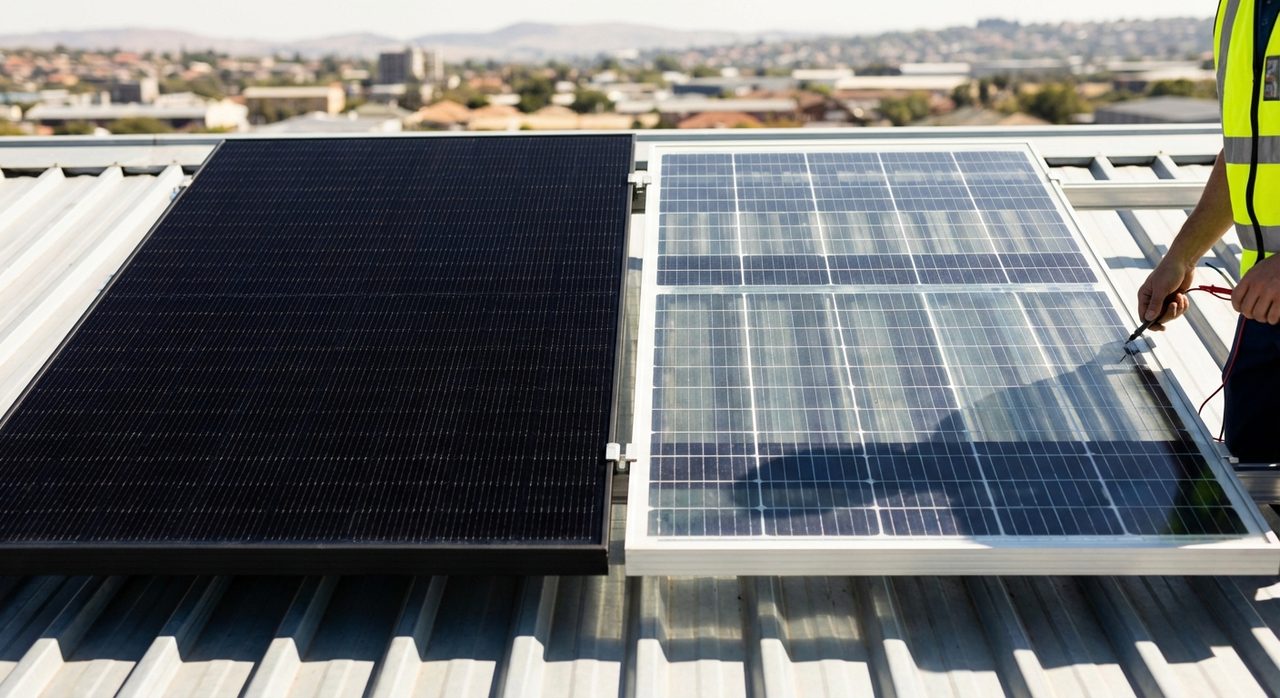
When a solar installer hands you a quote, you will see panel model names like LONGi Hi-MO 6, JinkoSolar Tiger Neo, or Trina Vertex S+. These are all different technologies with different efficiencies, temperature behaviours, and price points. Choosing the right panel type for your South African commercial system can affect your energy yield by 10–20% over the system lifetime — which is tens of thousands of rands.
This guide cuts through the marketing and explains what actually matters for a commercial or industrial rooftop in South Africa.
The Three Main Solar Panel Technologies
All mainstream solar panels available in South Africa today use crystalline silicon as the semiconductor material. The differences lie in how that silicon is structured and how the cell is engineered.
1. Monocrystalline Silicon (Mono)
Monocrystalline panels are cut from a single crystal of silicon grown in a controlled process. The uniform crystal structure allows electrons to move more freely, resulting in higher efficiency — typically 20–23% for modern PERC (Passivated Emitter and Rear Cell) or TOPCon (Tunnel Oxide Passivated Contact) variants.
Monocrystalline panels are identified by their uniform black or dark blue appearance. The cells are usually rectangular with slightly cut corners (the original Czochralski process) or fully rectangular in newer M10 and G12 wafer formats.
PERC monocrystalline adds a reflective layer at the rear of the cell to capture light that passes through the silicon, boosting efficiency by 1–2 percentage points over standard mono. This is now the baseline technology for any reputable Tier 1 panel.
TOPCon is the next generation, adding a thin tunnel oxide layer and doped polysilicon layer to further reduce recombination losses. TOPCon panels achieve 22–24% efficiency and have a lower temperature coefficient — important in South Africa's hot summers.
HJT (Heterojunction) panels combine crystalline silicon with thin amorphous silicon layers, achieving up to 25% efficiency. They are the most expensive option and currently used mainly in premium residential applications.
2. Polycrystalline Silicon (Poly)
Polycrystalline panels are made by melting silicon and allowing it to cool in a mould, forming multiple crystal structures. The manufacturing process is simpler and cheaper, but the grain boundaries between crystals impede electron flow, reducing efficiency to 15–18%.
You can identify poly panels by their speckled blue appearance — caused by the random crystal orientation reflecting light differently. Poly panels were the commercial standard from the 1990s through to roughly 2018, but are now largely obsolete for new commercial installations.
For South African buyers in 2026: avoid polycrystalline panels. The price gap versus monocrystalline PERC has collapsed to near zero, while the efficiency and temperature performance differences remain significant. There is no meaningful cost benefit to choosing poly over mono today.
3. Bifacial Panels
Bifacial panels (available in both mono and poly variants, though virtually all modern bifacial panels are monocrystalline) generate power from both the front and rear surfaces. The rear side captures light reflected off the ground, roof, or surrounding surfaces — called the "albedo gain".
Bifacial panels have a transparent rear sheet or dual glass construction. The additional energy yield depends heavily on what is beneath and around the panels. Albedo gain ranges from:
- 3–5% on dark IBR roofing (low albedo)
- 8–12% on white/grey concrete or light-coloured gravel
- 15–20% on ground-mount over white gravel or in snowy conditions
For commercial rooftops in South Africa — which are predominantly dark IBR sheeting — bifacial gain is minimal. Bifacial panels make excellent sense for ground-mounted systems on farms or industrial properties with light-coloured surfaces.
How South Africa's Climate Affects Panel Choice
South Africa receives 4.5–6.5 peak sun hours per day depending on location — exceptional solar resource. However, our climate presents specific challenges that should influence panel selection.
High Ambient Temperatures
Solar panels are rated at 25°C Standard Test Conditions (STC). In summer, roof-mounted panels in Gauteng, Limpopo, or the Northern Cape can reach 60–70°C operating temperature. All panels lose efficiency as temperature rises — this is the temperature coefficient.
A typical temperature coefficient of -0.30% per °C means a panel operating at 65°C (40°C above STC) loses 12% of its rated output just from heat. This is not a flaw — it is physics — but choosing panels with better (lower) temperature coefficients reduces the loss:
- Polycrystalline PERC: -0.37% to -0.40% per °C
- Monocrystalline PERC: -0.30% to -0.35% per °C
- TOPCon: -0.28% to -0.30% per °C
- HJT: -0.24% to -0.26% per °C
Over a 25-year South African system life, choosing TOPCon over polycrystalline can result in 5–8% more total energy yield from temperature performance alone — on top of the efficiency advantage.
Dust and Soiling
Highveld industrial areas, Karoo dust, and coastal salt spray all affect panel performance through soiling losses. Panels with textured anti-reflective glass clean better in rain and have lower soiling deposition. Most Tier 1 manufacturers now use tempered, anti-reflective glass as standard.
Bifacial dual-glass panels are more resistant to PID (Potential Induced Degradation) and moisture ingress than single-glass panels with backsheets — a longevity advantage in humid coastal environments like Durban or Cape Town.
UV Exposure
South Africa's high UV index accelerates EVA encapsulant yellowing and backsheet degradation in cheaper panels. Tier 1 manufacturers with strong warranty programmes use UV-resistant materials and have loss-rate data from global deployments.
Commercial Panel Sizing: Watt-Peak and Physical Dimensions
Modern commercial panels ship in large formats — 580Wp to 700Wp per panel for the latest M10 and G12 wafer sizes. This matters for rooftop projects because:
- Fewer panels mean fewer mounting brackets, connections, and labour hours — reducing BOS (balance of system) costs
- Larger panels generate more power per installation footprint when roof space is limited
- Heavier panels (dual glass bifacial panels weigh 30–35kg vs 22–25kg for standard) require stronger racking and wind load calculations
A typical 100kWp commercial system using 580Wp panels requires approximately 172 panels. The same system using 420Wp panels would require 238 panels — 66 more mounting points, cable runs, and connections, all of which add cost and potential failure points.
Tier 1 vs Tier 2 vs Tier 3 Manufacturers
The Tier 1 classification (from Bloomberg NEF) indicates manufacturers who have supplied bankable solar projects with confirmed independent financing. Tier 1 status does not directly measure panel quality, but it correlates with manufacturers who have the scale and track record to honour 25-year warranties.
Tier 1 manufacturers commonly sold in South Africa:
- LONGi Solar (China) — world's largest solar manufacturer
- JinkoSolar (China) — consistently top global shipment volumes
- Trina Solar (China) — strong commercial track record
- Canadian Solar (Canada/China) — widely used in SA utility projects
- JA Solar (China) — competitive PERC and TOPCon range
Warning signs for cheap panels in SA: No local distributor, no local warranty support, warranty period under 10 years product warranty, performance warranty below 80% at year 25, or no PV Evolution Labs (PVEL) test data.
What to Ask Your Solar Installer
When evaluating quotes, ask your installer these specific questions about the panels:
- What is the temperature coefficient? — Should be -0.35% or better for hot SA conditions.
- What is the product (materials) warranty? — Should be 12 years minimum; 15–25 years for Tier 1.
- What is the performance warranty degradation? — Year 1 degradation should be under 2%; annual thereafter under 0.55%.
- Is there local warranty support? — Who handles a defective panel claim in year 10?
- What is the PAN file for simulation? — Reputable installers use PVSyst or equivalent to model your specific roof with the actual panel datasheet.
- Are bifacial panels modelled with realistic albedo? — If a quote shows bifacial panels, verify what albedo coefficient was used and whether your roof actually supports bifacial gain.
Recommended Panel Specification for South African Commercial Projects (2026)
Based on current market availability, pricing, and South African conditions, here is what to specify for a new commercial solar system:
- Technology: Monocrystalline TOPCon or PERC (TOPCon preferred for large systems)
- Minimum efficiency: 21.5% (PERC) / 22.5% (TOPCon)
- Temperature coefficient: Better than -0.35%/°C
- Panel size: 540Wp–620Wp for optimal BOS cost balance
- Manufacturer: Tier 1 with local distributor
- Product warranty: 15 years minimum
- Performance warranty: 25 years, minimum 84.8% at year 25
Bifacial dual-glass panels are recommended for ground-mount systems on light-coloured surfaces and coastal environments for improved moisture resistance. For standard IBR rooftops inland, the bifacial premium is rarely justified by the albedo gain.
Realistic Energy Yield Expectations by Panel Type
For a 100kWp system on a north-facing commercial roof in Gauteng (Johannesburg area, ~5.5 peak sun hours):
- Polycrystalline PERC: ~140,000–145,000 kWh/year
- Monocrystalline PERC: ~148,000–155,000 kWh/year
- TOPCon: ~152,000–160,000 kWh/year
- Bifacial on dark IBR: ~150,000–158,000 kWh/year (minimal bifacial gain)
- Bifacial on light concrete: ~162,000–172,000 kWh/year (full bifacial gain)
At R2.20/kWh (mid-2026 Eskom tariff for large commercial consumers), the difference between polycrystalline and TOPCon on a 100kWp system is roughly R15,000–R33,000 in annual savings — or R375,000–R825,000 over 25 years. The panel price difference for 100kWp is typically R20,000–R40,000. The maths strongly favours TOPCon.
Conclusion
For any new commercial solar project in South Africa in 2026, monocrystalline TOPCon or PERC is the correct choice. Polycrystalline panels offer no meaningful cost saving and perform worse in our hot climate. Bifacial panels are genuinely valuable on ground-mount systems but offer limited upside on dark metal roofing.
Ask your installer for PVSyst modelling specific to your site, using the actual datasheet for the panels they're quoting. Manufacturers publish PAN files for all their panels, and any serious commercial installer should be using simulation software, not rule-of-thumb estimates.
The panel is the heart of a 25-year investment. Specify it carefully.