How to Size a Solar System for Your South African Business: A Practical Guide
Getting your solar system sizing right is the single most important technical decision in any solar project. An undersized system means disappointing savings and shortfalls during bad weather. An oversized system means unnecessary capital expenditure and panels that sit idle generating power you can't use or store. This guide walks you through the methodology professionals use — in plain language — so you understand the process and can assess whether the quotes you receive are reasonable.
Step 1: Understand Your Current Energy Consumption
The foundation of any solar sizing exercise is accurate data about your current electricity use. The best source of this data is your last 12 months of electricity bills. You want the kWh (kilowatt-hours) consumed each month, not the rand amount. If you only have the rand amount, divide by your tariff rate to get the kWh.
Reading Your Electricity Bill
South African commercial electricity accounts typically show energy charges (kWh consumed) and demand charges (kVA of peak demand). For solar sizing purposes, focus on the kWh figure. Collect 12 months of bills so you can see the seasonal variation — most businesses use more electricity in winter (heating, lighting earlier) or summer (air conditioning), and your solar system needs to be sized to handle this variation effectively.
Calculate Your Average Daily Consumption
Add up 12 months of kWh consumption and divide by 365 to get your average daily kWh. This is the baseline number your solar system is sized against. For example:
- Annual consumption: 120,000 kWh
- Daily average: 120,000 ÷ 365 = 329 kWh/day
Understand Your Load Profile
How you consume electricity matters as much as how much you consume. A business that runs mostly from 8am to 5pm on weekdays has a very different solar opportunity to a 24/7 operation like a cold storage facility or a hospital. For daytime-heavy operations, a larger portion of solar output is consumed directly (self-consumption), maximising savings. For round-the-clock operations, a substantial battery bank is needed to capture and store daytime solar for night-time use.
If possible, get an interval data download from your meter (available from most municipalities and Eskom for business accounts). This shows your consumption in 30-minute intervals and gives a detailed picture of when your peak demand occurs — invaluable for accurate sizing.
Step 2: Know Your Location's Solar Resource
South Africa is one of the sunniest countries on earth, but solar resources do vary across the country. The key metric is peak sun hours (PSH) — the number of hours per day when solar irradiance averages 1,000 W/m².
Peak Sun Hours by Region
- Northern Cape (Upington, Kimberley): 5.5–6.5 PSH/day
- North West (Rustenburg, Mahikeng): 5.2–5.8 PSH/day
- Gauteng (Johannesburg, Pretoria): 5.0–5.5 PSH/day
- Limpopo (Polokwane, Tzaneen): 5.0–5.5 PSH/day
- Mpumalanga (Nelspruit, Witbank): 4.8–5.3 PSH/day
- KwaZulu-Natal (Durban, Pietermaritzburg): 4.5–5.0 PSH/day
- Eastern Cape (Port Elizabeth, East London): 4.5–5.2 PSH/day
- Western Cape (Cape Town): 4.2–5.5 PSH/day (seasonal variation is higher — great in summer, reduced in winter)
For a more precise figure for your specific location, tools like PVWatts (by the US NREL) and the Global Solar Atlas provide accurate irradiation data for any coordinate.
Step 3: Calculate the Required Solar Array Size
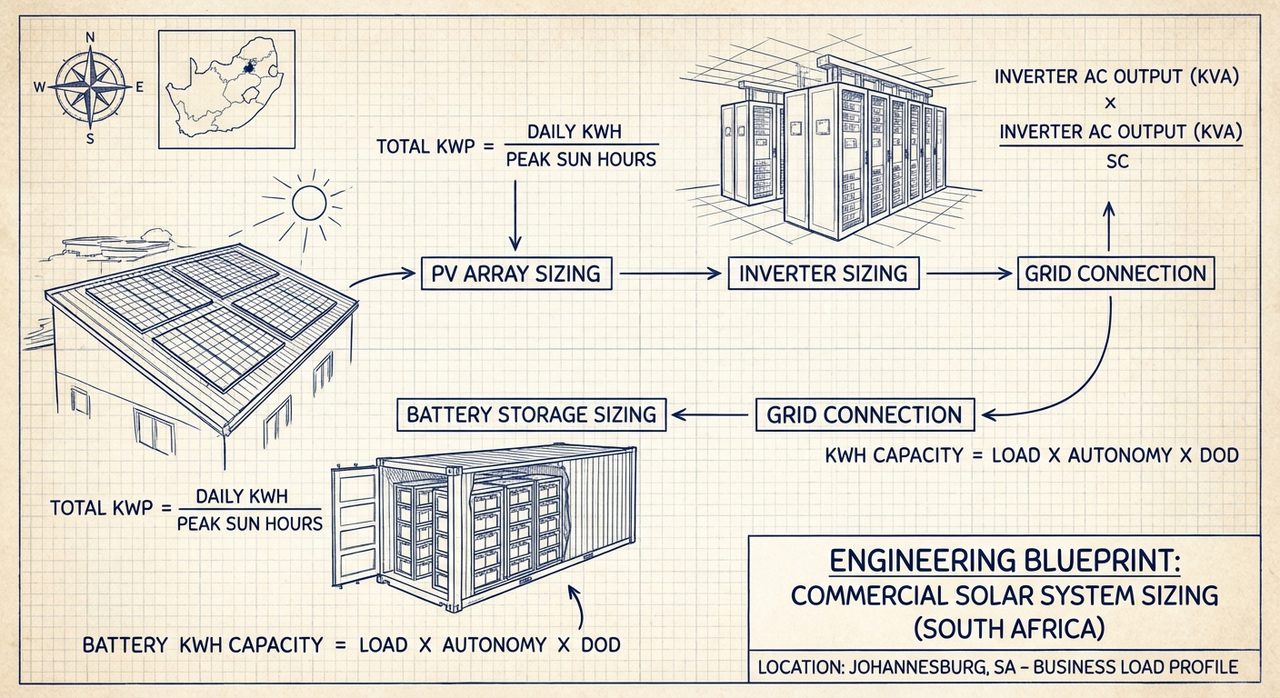
With your daily kWh consumption and your location's PSH, the basic array sizing formula is:
Array size (kWp) = Daily kWh needed ÷ Peak Sun Hours ÷ System Efficiency
System efficiency accounts for losses in wiring, inverter conversion, temperature effects, and panel soiling. A well-designed commercial system typically operates at 75–85% overall efficiency. Using 80% as a typical figure:
Worked Example
- Business in Gauteng
- Daily consumption: 200 kWh/day
- Target solar coverage: 70% (to offset grid draw during daylight hours)
- Daily solar target: 200 × 0.70 = 140 kWh/day
- Peak sun hours: 5.2
- System efficiency: 80%
- Array size = 140 ÷ 5.2 ÷ 0.80 = 33.7 kWp
In practice, this business would install a 35 kWp system (rounding up to a standard configuration). At current pricing, a 35 kWp grid-tied commercial system in South Africa would cost approximately R280,000–R420,000 installed.
Step 4: Size the Battery Bank (for Hybrid and Off-Grid Systems)
If you need load shedding protection or full off-grid capability, you need batteries. Sizing the battery bank correctly is a balancing act between autonomy (how many hours of backup you need), budget, and the loads you need to run during an outage.
Identify Your Critical Loads
During a power outage, you likely don't need to power everything. Identify the loads that are truly critical to your operations — the ones that, if they go off, cost you money or create a safety issue. Typical critical load lists:
- Computer servers and network equipment
- Point-of-sale systems and fridges/freezers
- Selected lighting circuits
- Security systems
- Essential production equipment
Non-critical loads like water heaters, air conditioners, and high-power machinery can typically be shed during an outage.
Calculate Battery Capacity
Add up all your critical loads in watts. Multiply by the hours of backup required. Add a 20% safety margin. Then divide by the battery's usable depth of discharge to get the minimum battery bank size in kWh.
Example: Critical loads total 5 kW, need 4 hours of backup = 20 kWh of energy needed. With 20% safety margin: 24 kWh. Using lithium batteries at 90% DoD: 24 ÷ 0.90 = 26.7 kWh minimum bank size. A 30 kWh lithium battery bank would comfortably cover this requirement.
Sizing for Load Shedding in South Africa
South Africa's load shedding schedule typically imposes outages in 2–2.5 hour blocks. For Stage 6 load shedding, a business might experience 4–6 such blocks per day — up to 12–15 hours of grid unavailability in extreme scenarios. For most businesses, a battery bank that handles 2–4 hours of critical loads covers the vast majority of outage scenarios, with the solar array recharging between events.
Step 5: Inverter and Structural Considerations
Inverter Sizing
Your inverter must be large enough to handle your peak simultaneous load. In a commercial setting, this is usually determined by the largest motor or piece of equipment you run, plus all other concurrent loads. For grid-tied systems, the inverter is typically sized at 80–100% of the array capacity. For off-grid systems, the inverter must be sized to handle peak load — which can be significantly higher than average load.
Roof Assessment
Every solar project needs a site assessment to confirm available roof space, roof condition, orientation, shading from nearby buildings or trees, and structural adequacy. A north-facing roof at a pitch of 15–25° is ideal in South Africa. East/west orientations still produce useful energy but at reduced efficiency. Flat roofs allow ballasted mounting at an optimised tilt angle.
As a rule of thumb, each kWp of solar requires approximately 6–8 m² of roof space. A 50 kWp array needs roughly 300–400 m² of unshaded roof area.
Common Sizing Mistakes to Avoid
- Using only monthly kWh without understanding the load profile — if you consume most electricity at night, a solar-only system won't help much without batteries
- Ignoring seasonal variation — a system sized for summer may underperform significantly in Cape Town's winter months
- Undersizing the battery bank to save money — a battery that runs flat after one load shedding block provides no protection for the second block
- Oversizing for future growth without load-managing today — a better approach is to design a system for current loads, installed on a platform that can be expanded
- Not accounting for shading — even partial shading of a single panel can reduce an entire string's output significantly with some inverter topologies
Getting Professional System Design
While this guide helps you understand the methodology and evaluate proposals intelligently, a commercial solar installation should always be professionally designed and installed. A reputable solar company will conduct a detailed site assessment, provide a load analysis, produce a shading analysis using specialist software (like PVSol or Helioscope), and design a system that is optimised for your specific situation.
Get at least three quotes from SAPVIA-accredited installers. Compare them not just on price, but on system design, component quality, warranty coverage, and track record. The cheapest quote is rarely the best value over a 25-year system life.
Related reading: Calculate Your Business Solar ROI | Solar Financing Options | Solar System Types Explained