Solar Battery Storage in South Africa: Lithium vs Lead-Acid — Which Should You Choose?
Battery storage is the component that transforms a solar system from a daytime electricity generator into a 24/7 power solution. It is also typically the most expensive single component in a hybrid or off-grid system, and the one that will require replacement during the system's life. Choosing the right battery technology has a bigger impact on your system's long-term economics than almost any other decision.
This guide compares the two dominant battery technologies for South African commercial solar — lithium-iron-phosphate (LiFePO4) and lead-acid — across every metric that matters for a real-world business installation.
The Two Main Technologies
Lithium-Iron-Phosphate (LiFePO4)
Lithium-iron-phosphate is a specific lithium chemistry that has become the dominant choice for solar energy storage. Unlike the lithium-ion batteries in smartphones and laptops (which use cobalt-based chemistry), LiFePO4 batteries are thermally stable, non-flammable under normal conditions, and designed specifically for deep-cycle applications. When South African solar installers and suppliers talk about "lithium batteries," they almost always mean LiFePO4.
Well-known brands available in South Africa include Pylontech, BYD, Hubble Lithium, BlueNova (locally manufactured), Freedom Won, and Dyness. These are rack-mounted or wall-mounted modules that communicate with compatible hybrid inverters via CAN bus or RS485 protocols, enabling intelligent battery management.
Lead-Acid Batteries
Lead-acid is the oldest rechargeable battery technology and remains in widespread use due to its lower upfront cost and familiarity. Three main variants are used in solar applications:
- Flooded lead-acid (FLA): The traditional wet-cell battery. Lowest cost per kWh, longest potential lifespan with proper maintenance, but requires regular electrolyte top-ups, adequate ventilation (produces hydrogen gas), and cannot be installed in enclosed spaces without specialised ventilation.
- Absorbed Glass Mat (AGM): Sealed, maintenance-free, can be installed in any orientation. More expensive than flooded, less so than lithium. Good cycle life when not over-discharged. The most common lead-acid choice for commercial installations.
- Gel: Similar to AGM but uses a gel electrolyte. Better performance at high temperatures — relevant in hot South African conditions. Slightly more expensive than AGM. Sensitive to overcharging.
Head-to-Head Comparison
Cycle Life and Lifespan
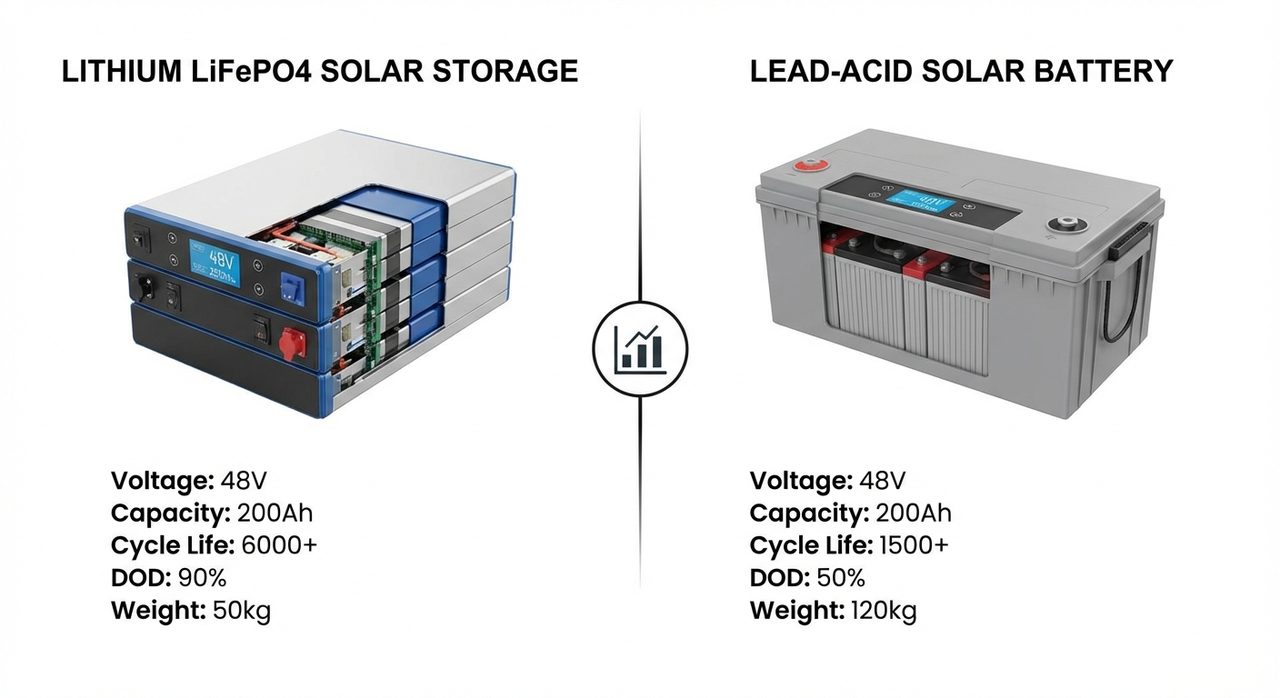
This is where lithium batteries win most decisively. Cycle life refers to the number of complete charge-discharge cycles a battery can deliver before capacity degrades to 80% of rated capacity.
- LiFePO4: 3,000–6,000 cycles at 80% depth of discharge (DoD). At one cycle per day (typical for load shedding backup), this translates to 8–16 years of service life.
- AGM lead-acid: 300–800 cycles at 50% DoD. At one cycle per day, this is less than 2.5 years at full cycling. In practice, South African commercial batteries are typically replaced every 4–6 years.
- Quality flooded lead-acid: 500–1,200 cycles at 50% DoD with proper maintenance — marginally better than AGM.
Depth of Discharge (DoD)
DoD refers to how much of the battery's rated capacity can be used without causing damage or significantly shortening lifespan.
- LiFePO4: Can be discharged to 80–90% DoD routinely. A 10 kWh lithium battery delivers 8–9 kWh of usable energy.
- Lead-acid: Should not be discharged below 50% DoD regularly, and ideally kept above 40%. A 10 kWh lead-acid bank delivers only 4–5 kWh of usable energy before risking damage.
This means that to achieve the same usable energy storage, a lead-acid bank needs to be nearly twice the rated capacity of a lithium bank. This narrows the cost gap significantly.
Round-Trip Efficiency
Round-trip efficiency is the percentage of energy that comes out of the battery relative to what went in.
- LiFePO4: 95–98% round-trip efficiency. For every 100 kWh stored, you get 95–98 kWh out.
- Lead-acid: 75–85% round-trip efficiency. For every 100 kWh stored, you get 75–85 kWh out.
Over a year of daily cycling, this efficiency difference compounds. A system storing 20 kWh/day loses 730 kWh per year to inefficiency with lead-acid (roughly R1,500–R2,000 at current tariffs) versus about 150 kWh with lithium. Over 10 years, lithium's efficiency advantage represents R15,000–R20,000 in additional electricity value.
Temperature Performance
South African summers can push temperatures well above 30°C in industrial environments and roof-mounted battery enclosures. Both technologies are affected by heat, but differently:
- LiFePO4: Performs well from -20°C to 60°C operating range, with optimal charging between 0°C and 45°C. Most lithium battery management systems (BMS) automatically throttle charging above 45°C to protect the cells.
- Lead-acid: Capacity decreases significantly above 30°C and lifespan shortens materially above 25°C sustained temperature. Every 10°C above 25°C approximately halves lead-acid battery lifespan. In a hot factory or outdoor enclosure, lead-acid batteries may degrade 2–3 times faster than their spec-sheet cycle life suggests.
For installations in hot environments — industrial rooftops, Limpopo farms, Northern Cape lodges — lithium's thermal performance advantage is especially significant.
Weight and Space
- LiFePO4: Approximately 5–7 kg per kWh of storage. A 20 kWh lithium system weighs roughly 100–140 kg and fits in a compact rack-mounted unit.
- Lead-acid: Approximately 25–35 kg per kWh. A 20 kWh usable lead-acid system (requiring 40 kWh rated capacity due to 50% DoD) weighs 1,000–1,400 kg and requires substantial floor space and structural support.
For rooftop or wall-mounted installations, the weight difference is not academic — it determines whether the installation is structurally feasible at all.
Maintenance Requirements
- LiFePO4: Essentially maintenance-free. The built-in BMS manages cell balancing, temperature protection, and state-of-charge monitoring. Remote monitoring via app provides visibility without physical inspection.
- AGM/Gel lead-acid: Sealed and maintenance-free, but should be professionally inspected annually to check connections and verify performance.
- Flooded lead-acid: Requires monthly electrolyte level checks and top-ups with distilled water. Terminals must be inspected for corrosion. Quarterly equalisation charges are recommended. Ventilation must be maintained to safely exhaust hydrogen gas.
Safety
- LiFePO4: The safest lithium chemistry. Does not undergo thermal runaway under normal conditions. Can be installed indoors, in server rooms, or alongside sensitive equipment. No gas emission during normal operation.
- Lead-acid (flooded): Emits hydrogen gas during charging — a fire and explosion risk if ventilation is inadequate. Must be installed in a ventilated enclosure separate from occupied areas.
- Lead-acid (AGM/Gel): Sealed, so no gas emission under normal charging. Safer than flooded for indoor installation.
Cost Comparison: The Full Picture
The price gap between lithium and lead-acid has narrowed substantially. Current indicative prices in South Africa (2026):
- LiFePO4: R3,000–R5,000 per kWh of rated capacity (installed)
- AGM lead-acid: R1,500–R2,500 per kWh of rated capacity (installed)
But to compare fairly, you must account for DoD. To achieve 10 kWh of usable storage:
- Lithium (90% DoD): Need 11 kWh rated → R33,000–R55,000
- AGM (50% DoD): Need 20 kWh rated → R30,000–R50,000
The upfront cost is now roughly equivalent. But lithium lasts 10–15 years versus 4–6 years for AGM, meaning lead-acid needs replacement 2–3 times over the solar system's life. On a whole-of-life cost basis, lithium is almost always less expensive.
Which Should You Choose?
For new commercial solar installations in South Africa, the recommendation is clear: choose lithium-iron-phosphate unless budget is severely constrained and the application genuinely suits lead-acid.
Lead-acid still makes sense for:
- Temporary or short-term installations where system replacement is planned within 5 years
- Very low cycling applications (e.g., emergency backup that rarely discharges)
- Budget-constrained small systems where the upfront cost difference is decisive
For everything else — especially 24/7 commercial operations, remote lodges, and any application with daily cycling — lithium's superior cycle life, efficiency, DoD, and maintenance profile make it the better investment.
See our solar solutions overview for more on system design, or read our off-grid vs hybrid comparison to understand how battery sizing differs between system types.