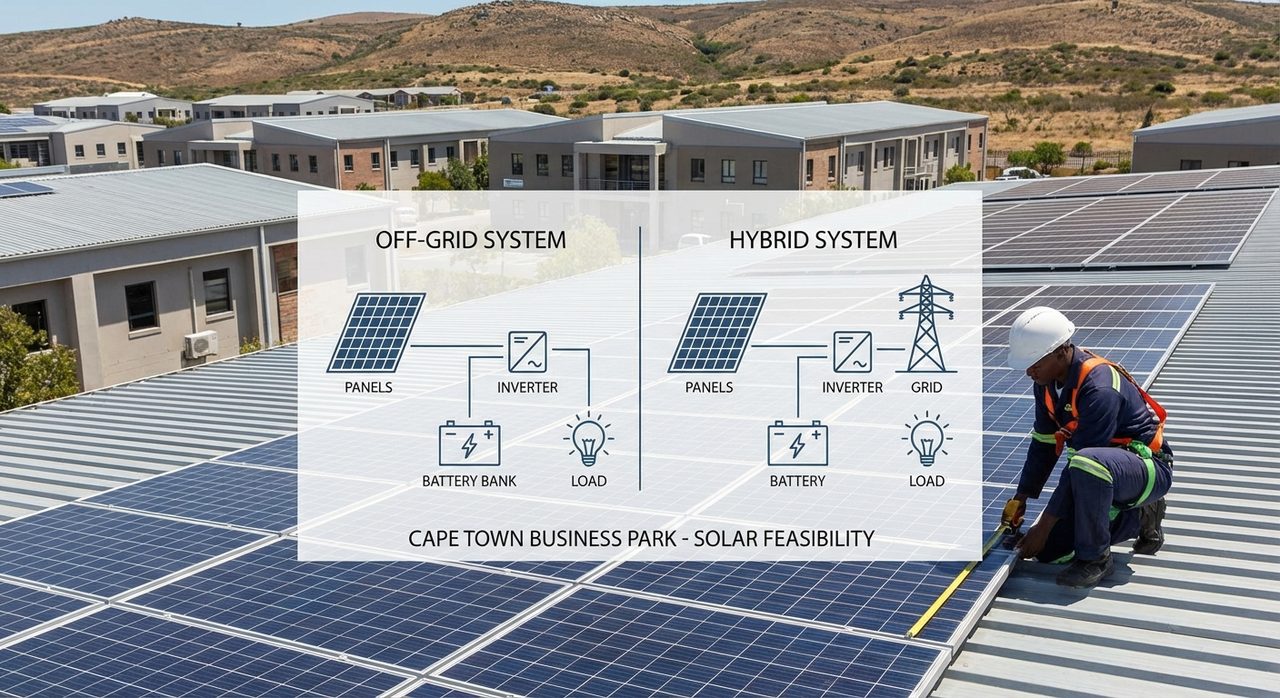
Off-Grid vs Hybrid Solar in South Africa: A Side-by-Side Comparison
Both off-grid and hybrid solar systems offer protection against load shedding and, in the right conditions, can achieve complete energy independence. But they are fundamentally different in how they work, what they cost, and which situations they suit best. Choosing the wrong architecture is an expensive mistake — this guide helps you choose correctly.
The Core Difference: Grid Connection
The fundamental distinction between off-grid and hybrid solar systems is whether your premises remains connected to the municipal electricity grid.
- Hybrid systems are connected to the grid and use the grid as a backup source of energy when solar production and battery storage are insufficient. The hybrid inverter manages the flow of power between solar, batteries, grid, and loads automatically and intelligently.
- Off-grid systems have no grid connection. They rely entirely on solar panels and batteries to supply all electricity needs. A generator is typically included as a backup for extended periods of insufficient solar production, but the grid plays no role.
This single difference has cascading implications for system design, cost, complexity, and resilience.
Hybrid Solar Systems in South Africa
How Hybrid Systems Operate
A hybrid system's inverter-charger operates according to a priority hierarchy programmed by the installer and owner:
- Solar powers your loads directly (free electricity)
- Excess solar charges the battery bank
- When loads exceed solar production, batteries supplement
- When batteries reach a set minimum state-of-charge, the grid takes over
- When the grid fails (load shedding), the system switches to battery-only or solar + battery mode
This means your facility has a tiered, resilient energy supply. On a good sunny day with low consumption, you may not draw a single unit from the grid all day. During load shedding at night, you run on batteries. During a week of overcast winter weather, the grid provides whatever solar and batteries cannot.
Time-of-Use Optimisation
A major financial advantage of hybrid systems that is often overlooked: time-of-use (TOU) tariff optimisation. Many commercial electricity consumers pay peak tariff rates (typically 6am–9am and 6pm–9pm) that are 3–5 times higher than off-peak rates. A smart hybrid inverter can be programmed to charge batteries from cheap off-peak grid electricity and discharge during expensive peak periods — even on days with no load shedding. This can add 15–25% to the system's total financial return.
Who Should Choose Hybrid Solar
- Businesses in Johannesburg, Pretoria, Cape Town, Durban, or other urban centres with grid access
- Operations that need 24/7 reliability but with the grid as a safety net
- Businesses where the primary driver is cost reduction plus load shedding protection
- Facilities with variable or unpredictable energy consumption patterns
- Anyone who wants to avoid the complexity of managing a fully off-grid system
Hybrid System Costs
For South African businesses in 2026, indicative installed hybrid system costs include:
- Small office (10 kWp + 15 kWh lithium): R200,000–R300,000
- Medium business (30 kWp + 30 kWh lithium): R450,000–R650,000
- Large commercial (100 kWp + 100 kWh lithium): R1.3–R2.0 million
Off-Grid Solar Systems in South Africa
How Off-Grid Systems Operate
An off-grid system must be designed to meet 100% of a facility's electricity needs from solar and battery storage, in all conditions. This requires:
- A solar array large enough to meet peak summer consumption AND charge the batteries
- A battery bank large enough to carry the facility through nights and multiple consecutive cloudy days
- A backup generator for extended cloudy periods (typically auto-start, runs 2–6 hours to recharge batteries)
- Careful load management to avoid battery depletion
The design challenge is balancing the worst-case scenario (consecutive cloudy winter days) against average conditions. An off-grid system designed only for average conditions will fail in winter. One designed for the absolute worst case may be over-engineered for 90% of operating days.
Generator Integration
Almost every commercial off-grid installation in South Africa includes a generator backup, even if it rarely runs. Modern off-grid inverter-chargers include automatic generator start (AGS) functionality: when battery state-of-charge drops to a set threshold, the inverter starts the generator, recharges the batteries to a set level (e.g., 80%), then stops the generator. In a well-designed system, the generator might run 5–15 hours per month during winter — a small fraction of its capacity, but an essential insurance policy.
Who Should Choose Off-Grid Solar
- Game farms, safari lodges, and remote guesthouses where grid connection is unavailable or prohibitively expensive
- Agricultural operations in rural areas not served by the grid
- Telecoms towers and remote infrastructure
- Any facility where the cost of grid connection (Eskom connection charge) exceeds the incremental cost of off-grid over hybrid
- Businesses that want complete independence from Eskom — as a matter of principle or strategic resilience
The Financial Case for Off-Grid at Remote Locations
For a remote lodge currently running a 30 kVA diesel generator 16 hours per day, the annual cost calculation is sobering:
- Diesel consumption: approximately 8 litres/hour × 16 hours × 365 days = 46,720 litres/year
- Diesel cost at R24/litre: R1,121,280/year
- Generator maintenance: R80,000/year
- Generator depreciation: R25,000/year
- Total annual generator cost: approximately R1.23 million
An off-grid solar system that eliminates the need for daytime generator running and reduces total generator hours by 90% would cost R800,000–R1.5 million installed and pay for itself in fuel savings within 1–2 years. The system then continues delivering value for the next 23+ years with near-zero operating cost.
Off-Grid System Costs
- Small lodge (10 kWp + 30 kWh battery + 10 kVA generator): R280,000–R450,000
- Medium lodge (30 kWp + 60 kWh battery + 20 kVA generator): R550,000–R900,000
- Large lodge (80 kWp + 150 kWh battery + 50 kVA generator): R1.4–R2.5 million
Direct Comparison: Off-Grid vs Hybrid
Cost
Hybrid wins for urban businesses. Because the grid acts as backup, hybrid systems don't need to be sized for worst-case autonomy. Batteries can be smaller. For the same level of load shedding protection, a hybrid system is typically 20–40% less expensive than an equivalent off-grid system. For remote locations, the comparison changes because the cost of grid extension must be factored in.
Reliability
Off-grid wins for remote locations; roughly equal for load shedding protection. A hybrid system depends on the grid being available outside load shedding hours. If your area suffers from infrastructure damage, cable theft, or other grid reliability issues beyond standard load shedding, a hybrid system's battery may be depleted by the time load shedding hits. Off-grid systems don't have this vulnerability.
Complexity
Hybrid is simpler. With the grid as a backup, the consequences of a cloudy week are minor — the grid supplements. Off-grid requires more careful load management, more attentive battery monitoring, and more disciplined energy use by staff and guests.
Energy Independence
Off-grid wins completely. If your goal is total independence from Eskom and municipal electricity providers — for ideological, strategic, or practical reasons — only off-grid achieves this.
Long-term Operating Cost
Off-grid may win at remote locations. In urban settings, the hybrid system's grid backup is inexpensive per kWh and available on demand. At remote locations where grid power is unavailable, the off-grid system eliminates fuel costs that are very high per kWh.
Making the Decision
The decision framework is straightforward in most cases:
- Grid available and affordable to maintain connection → Hybrid system
- No grid or grid connection prohibitively expensive → Off-grid system
- Grid technically available but you want complete independence → Off-grid system (premium for principle)
- Grid reliability is poor beyond normal load shedding → Consider off-grid or oversized hybrid with larger battery bank
Read our full solar solutions overview for more detail on system components. If you're a lodge owner, our complete off-grid lodge solar guide covers remote solar system design in depth.