Complete Off-Grid Solar Guide for Remote Lodges in South Africa
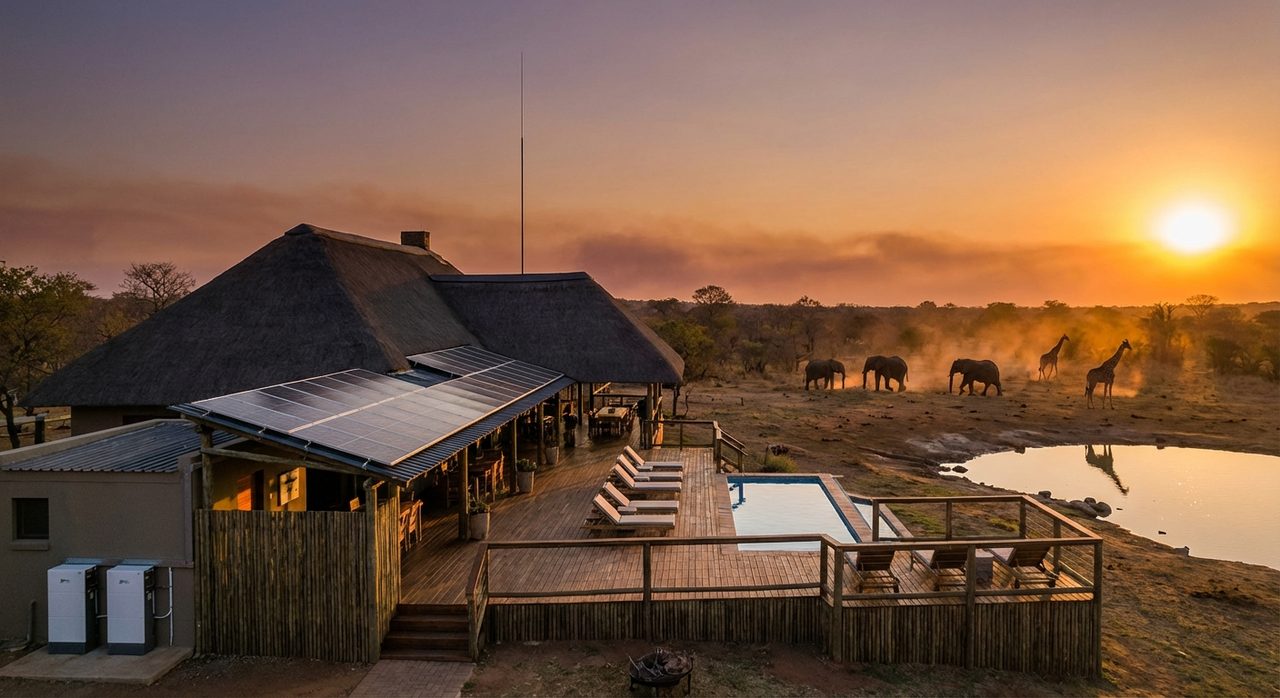
South Africa is home to some of the world's most spectacular remote lodge destinations — from the Limpopo bushveld to the Karoo plains and the KwaZulu-Natal coastline. But running a remote lodge means confronting an energy challenge that grid-connected businesses never face: how do you deliver a world-class guest experience when the nearest power line is 50 kilometres away?
Off-grid solar has transformed the economics and reliability of remote lodge power. Where diesel generators once meant constant noise, fuel logistics, high running costs, and regular breakdowns, a modern solar-plus-storage system delivers silent, reliable, sustainable power — often at a lower total cost over time. This guide covers everything you need to know to design, size, and invest in the right system for your lodge.
Step 1: Understanding Your Lodge's Energy Demand
Every off-grid system starts with a detailed energy audit. Unlike urban properties where you can check a utility bill, a remote lodge energy assessment must account for:
- Accommodation capacity — number of chalets, rooms, or tents, and their typical occupancy
- Kitchen and catering — commercial kitchen appliances are major energy consumers
- Hot water — electric geysers or heat pumps represent significant daily load
- Refrigeration — fridges, freezers, wine storage, walk-in cold rooms run 24/7
- Air conditioning — major load in hot months; consider whether AC is essential or a fan will suffice
- Lighting — LED throughout is non-negotiable for an off-grid lodge
- Pump systems — borehole pumps, pool pumps, irrigation
- Entertainment and communication — TV, satellite, Wi-Fi, security systems
- Workshop and maintenance — power tools, vehicle charging, staff accommodation
Step 2: Sizing the Solar Array
South Africa is exceptionally well-positioned for solar generation. Most of the country receives 4.5–6.5 peak sun hours per day, with inland areas like Limpopo, Mpumalanga, Northern Cape and Free State at the higher end.
To size your solar array:
- Calculate your daily energy consumption in kWh (from the energy audit)
- Divide by the peak sun hours at your location (use 5 hours as a conservative estimate)
- Multiply by 1.25 to account for system losses (inverter efficiency, cable losses, soiling)
Example: A lodge consuming 120kWh/day in Limpopo: 120 ÷ 5 × 1.25 = 30kWp minimum solar array.
Panel Sizing for Common Lodge Types
| Lodge Type | Daily Consumption | Solar Array Size | Notes |
|---|---|---|---|
| Small bush camp (4–6 units) | 40–80kWh | 12kWp – 25kWp | Minimal appliances, fans not AC |
| Mid-range lodge (8–12 units) | 80–180kWh | 25kWp – 55kWp | Full kitchen, some AC |
| Luxury lodge (12–20 units) | 180–350kWh | 55kWp – 110kWp | Full AC, pool, spa, large kitchen |
| Large resort (20+ units) | 350kWh+ | 110kWp+ | Multiple inverters, custom design |
Step 3: Battery Storage — The Heart of the Off-Grid System
Unlike a grid-tied system that can rely on the grid at night, an off-grid lodge must store enough energy to power through the night and cloudy periods. Battery sizing is critical.
How Much Battery Storage Do You Need?
A conservative rule for lodge applications: store at least 1.5 days of consumption in your battery bank. This provides cover for one full overcast day without generator backup. For high-end lodges where generator use must be invisible to guests, 2 days of storage is preferred.
Example: 120kWh/day lodge → 120 × 1.5 = 180kWh usable battery capacity.
Lithium vs Lead-Acid for Remote Lodges
For remote lodge applications, lithium iron phosphate (LiFePO4) is strongly recommended:
- Deep cycle capability (80–90% DoD) means smaller physical footprint for same usable capacity
- 10+ year lifespan significantly reduces replacement logistics to a remote location
- No maintenance (no water topping, no equalization cycles)
- No hydrogen gas — can be installed indoors in a dedicated battery room
- Better performance in high ambient temperatures
The higher upfront cost of lithium is consistently justified in remote lodge applications, where the cost of logistics, downtime, and replacement at a distant location amplifies the value of longevity and reliability.
Step 4: The Inverter System
A large lodge will typically require a three-phase inverter system or multiple single-phase inverters configured in parallel. Key considerations:
- Peak capacity — the inverter must handle startup surges from motor loads (pumps, compressors, air conditioners)
- Scalability — modular inverter systems allow future capacity addition without system replacement
- Remote monitoring — essential for remote locations; you need real-time visibility of system status via cellular or satellite
- Generator integration — the inverter must seamlessly accept generator input when solar and battery are insufficient
Popular choices for commercial lodge applications include Victron Energy, SMA, and Growatt commercial inverters. Victron is particularly popular in South African remote applications for its robust remote monitoring (VRM portal) and proven field reliability.
Step 5: The Backup Generator — Still Part of the Plan
Even with a properly sized off-grid solar system, most remote lodges retain a backup diesel or LPG generator. This is not a failure of the solar system — it's prudent engineering for a business that cannot afford guest-facing power failures.
The key shift is in how the generator is used:
After solar: Generator runs 50–200 hours per year as backup only, consuming 2,000–8,000 litres. Fuel cost drops by 90–95%.
Size your generator to cover your lodge's full load plus charge the batteries in reasonable time (typically a generator sized at 30–50% of peak solar array capacity works well as backup).
Step 6: Hot Water — Don't Ignore It
Electric geysers are the single biggest energy consumer in most accommodation properties. A single 150L geyser uses 3kWh to heat from cold. Multiply by 10 chalets and you have 30kWh just for hot water — 25% of total daily consumption in our mid-range lodge example.
Strategies for remote lodge hot water:
- Solar thermal water heating — separate solar hot water panels (not PV) are highly efficient for water heating and reduce electrical load significantly
- Heat pump water heaters — use 3–4x less electricity than element geysers to produce the same hot water (COP of 3–4)
- Timer control — heat water only during peak solar generation hours (10:00–15:00)
- Insulation — properly insulated geysers retain heat and reheat less frequently
Marketing Value: The Eco Lodge Premium
Beyond the operational economics, solar power creates real marketing value for South African lodges. International visitors in particular — from Europe, the UK, the US, and Australasia — are increasingly choosing accommodation based on sustainability credentials.
A fully solar-powered lodge can legitimately market:
- Carbon-neutral or net-zero accommodation
- Zero load shedding impact (no diesel generator noise)
- Starlight experience uninterrupted by generator hum
- Contribution to South Africa's renewable energy transition
Many lodge owners report that solar power allows them to command a modest premium on room rates while improving occupancy from eco-conscious travellers — adding revenue that further improves ROI. See our analysis of Solar ROI for South African businesses for the numbers.
Indicative Costs for Remote Lodge Solar Systems (2026)
| System Configuration | Approx. Installed Cost |
|---|---|
| 15kWp solar + 40kWh lithium battery + 10kVA inverter | R600,000 – R900,000 |
| 30kWp solar + 80kWh lithium + 20kVA inverter | R1.1M – R1.7M |
| 60kWp solar + 160kWh lithium + 40kVA inverter | R2.2M – R3.2M |
| 100kWp solar + 300kWh lithium + 60kVA inverter | R3.8M – R5.5M |
Prices vary significantly based on location (transport and installation costs increase with remoteness), equipment specification, and current exchange rates for imported components.
Next Steps: Getting Your Lodge Quote Right
The most important investment before committing to a system is a proper energy audit and site assessment. A reputable installer will visit your property, assess your load profile, analyse your sun hours and shading, and design a system specifically for your lodge's needs.
Be wary of generic quotes generated without a site visit — remote lodge solar systems are custom engineering projects, not off-the-shelf products.
Contact us to discuss your lodge's requirements or explore our off-grid solutions for more information.
Frequently Asked Questions
How much does an off-grid solar system cost for a remote lodge in South Africa?
Costs vary enormously based on lodge size and energy demand. A small 4-chalet bush lodge might need a 15kWp system with 40kWh battery storage, costing R600,000–R900,000 installed. A larger 20-chalet luxury lodge may require 80kWp+ with 200kWh+ storage, at R3M–R6M. The comparison is always made against the alternative: grid connection cost (which can be R500,000–R5M for a remote site) plus ongoing grid tariffs, or diesel generator running costs.
Can guests charge electric vehicles at an off-grid solar lodge?
Yes, but EV charging adds significant load and must be planned for in system design. A standard 7kW home charger running for 4 hours adds 28kWh to your daily demand — equivalent to powering several chalets. If you want to offer EV charging, size your solar and battery system to accommodate it and consider time-of-day restrictions (charge during peak solar hours only).
Do I still need a diesel generator with an off-grid solar system?
Most remote lodges retain a backup generator even with a full off-grid solar system. The generator serves as a backup for extended cloudy periods, unusual high-demand events, or system maintenance. However, with a well-sized solar and battery system, generator runtime typically drops to less than 5% of total operating hours — saving 95%+ of your diesel costs.
How does off-grid solar affect the lodge guest experience?
A well-designed off-grid system is completely invisible to guests — the experience is identical to grid power. Guests get reliable lighting, working appliances, hot water, air conditioning (if designed for), and phone charging without interruption. Many lodges actively market their solar-powered, eco-friendly status as a selling point that attracts environmentally conscious guests.
What is the best battery technology for a remote lodge solar system?
Lithium iron phosphate (LiFePO4) is strongly recommended for remote lodge applications. The longer lifespan (10+ years), deeper discharge capability, and reduced maintenance requirements are critical advantages when you cannot easily service batteries at a remote location. The higher upfront cost is justified by the reduced replacement and maintenance burden over the system lifetime.