Commercial Solar Maintenance Guide for South African Businesses
Published: March 2026 | Category: Operations & Maintenance
A commercial solar system on your business roof is a 25-year investment. During those 25 years, it will produce roughly 3–5 million kWh and save your business hundreds of thousands — or millions — of rands in electricity costs. But only if it is properly maintained.
Most South African solar installers hand over a system, shake your hand, and leave. Ongoing maintenance is often an afterthought. This guide gives you a practical maintenance framework to keep your system performing at close to nameplate capacity for its full useful life.
Why Maintenance Matters More Than You Think
Solar panels are passive devices — no moving parts, no fluids. It is easy to assume they require no attention. This assumption costs money.
Research from the University of Pretoria and monitoring data from large SA commercial installations consistently shows that unmanaged systems lose 1–3% of their expected output annually beyond normal degradation — through soiling, connection issues, inverter inefficiencies, and undetected faults. Over a 25-year system life, a poorly maintained system may produce 15–25% less energy than a well-maintained equivalent.
At current electricity tariffs, that is R150,000–R400,000 in unrealised savings for a typical 100kWp commercial system.
The Annual Maintenance Schedule
Quarterly: Visual Inspection and Monitoring Review
Every three months, carry out the following checks yourself or ask your maintenance provider to perform them:
- Panel visual inspection: Check for cracked panels, delamination (bubbling), discolouration, bird droppings accumulation, or physical damage from hail or debris. Walk the roof if safe to do so, or use a drone if the roof is large or not walkable.
- Soiling assessment: Look at the panel glass. Heavy dust accumulation is visible. If panels in an open area look significantly lighter than others, soiling is uneven and costing you yield.
- Mounting and racking: Check that mounting rails are still secure. Loose brackets or rail movement from thermal expansion and contraction should be caught early before wind damage occurs.
- Inverter status lights: Most string and hybrid inverters have status LEDs. A consistent yellow or red warning light that was not there before warrants investigation.
- Monitoring data review: Review your inverter monitoring portal (SolarEdge, SMA, Growatt, Deye, etc.) and compare current month's yield against the same month in the previous year. A drop of more than 5% beyond expected degradation indicates a problem.
Bi-Annual: Professional Panel Cleaning (Critical)
Panel cleaning in South Africa is not optional. Our combination of dry seasons, Highveld dust, agricultural dust, industrial pollution, and bird activity means panels accumulate a performance-robbing soiling layer consistently throughout the year.
When to clean:
- September/October: Before peak summer production season (highest sun hours November–February). Clean panels entering summer maximise your most productive months.
- March/April: After summer, to clear autumn dust and prepare for winter (lower but consistent production).
How cleaning should be done:
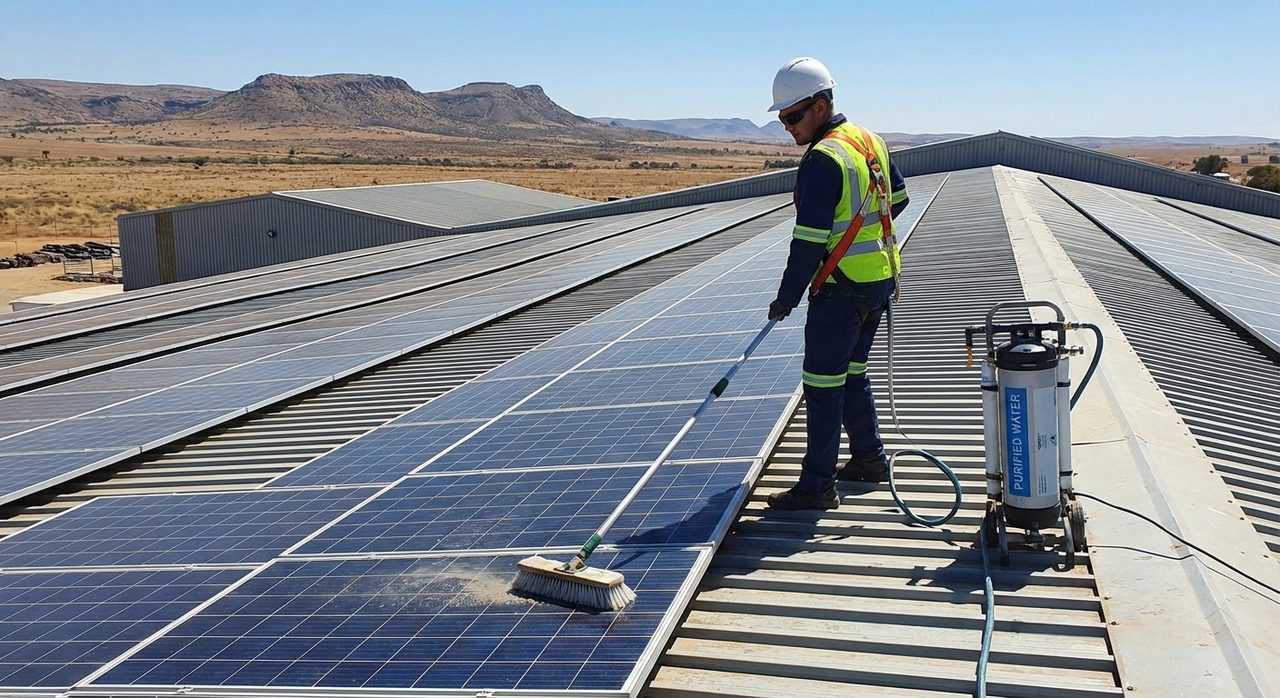
- Use deionised or purified water with a soft brush or squeegee. Tap water leaves mineral deposits as it evaporates.
- Clean in early morning or late afternoon — never on hot panels in full sun. Thermal shock from cold water on hot panels can stress tempered glass.
- Never use pressure washers (can damage frame seals and void warranties).
- Never use abrasive cloths or cleaning agents with ammonia.
- The cleaning provider should be safety-compliant for roof work — roof harnesses, anchor points, and appropriate PPE.
Measuring cleaning impact: A good monitoring system will show a measurable yield increase on the day after a professional clean. Expect 3–8% improvement in daily yield in high-dust conditions.
Annual: Full Technical Inspection
Once per year, a qualified electrical technician (or your installer's O&M team) should carry out a full technical inspection covering:
Electrical Connections
DC cable connections, MC4 connectors, and AC cable terminations should be checked for tightness, corrosion, and overheating signs. Loose connections cause resistive heating (hot spots) that degrade performance and can cause fires. A thermal (infrared) camera inspection of the DC distribution board and inverter terminals is the most effective way to identify resistive hot spots before they become faults.
String Performance Testing
Each string of panels should be tested for open-circuit voltage and short-circuit current. These measurements, compared against expected values from the PV string calculator (based on the number of panels, temperature, and irradiance at time of test), identify failed or degraded panels within a string. A single failed panel reduces the output of its entire string.
Inverter Service
The inverter is the most complex and failure-prone component in a solar system. Annual service includes:
- Firmware update to the latest stable release
- Fan inspection and cleaning (cooling fans in inverters accumulate dust and can seize, causing thermal shutdowns)
- Capacitor condition check (electrolytic capacitors degrade over time and are a common inverter failure point)
- Error log review from the inverter's internal log
- Communication module (Wi-Fi, Ethernet, RS485) function check
Battery Health Assessment (If Applicable)
For systems with battery storage:
- LiFePO4 batteries: Review State of Health (SoH) data from the BMS. LiFePO4 batteries should maintain 80%+ capacity for 3,000–6,000 cycles. Check for cell voltage imbalance, which indicates a cell nearing end of life.
- Lead-acid batteries: Check electrolyte levels (flooded lead-acid), check specific gravity with a hydrometer, carry out a discharge test to measure actual available capacity, and clean terminal connections.
- Battery room/enclosure: Check ventilation (critical for lead-acid due to hydrogen off-gassing), ensure temperature is within operational range, check for any swelling or deformation of battery cases.
Earthing and Lightning Protection
South Africa's summer lightning storms — particularly on the Highveld — are among the world's most intense. The rooftop mounting system must be continuously bonded and earthed. Check that earth bonds are intact and that any surge protection devices (SPDs) installed in the DC and AC circuits have not been tripped or consumed. SPDs are sacrificial devices that need replacement after a surge event.
Performance Monitoring: Your Early Warning System
Every commercial solar system should have remote monitoring enabled. All mainstream inverter brands (Growatt, Deye, Sunsynk, SMA, SolarEdge, Huawei) provide cloud monitoring platforms. These give you:
- Daily, monthly, and lifetime yield data
- Current power output vs system capacity
- Self-consumption ratio (how much solar you actually use)
- Feed-in to grid (if applicable)
- Battery state of charge (for hybrid systems)
- Fault and alarm alerts via email or SMS
Performance ratio (PR) is the most useful metric: it compares actual energy output to the theoretical maximum given the measured irradiance. A healthy commercial system in South Africa should have a PR of 75–85%. A drop below 70% indicates a maintenance issue worth investigating.
If your installer did not set up monitoring, or you cannot access the monitoring portal, remedy this immediately. Monitoring is essential — running a solar system without it is like driving with no dashboard instruments.
Common Fault Symptoms and What They Mean
| Symptom | Likely Cause | Action |
|---|---|---|
| Output drops sharply during sunny day | Inverter thermal shutdown; DC isolator tripped; MPPT fault | Check inverter temperature and fault log; call technician |
| One string underperforming vs others | Failed panel, shading, loose MC4 connector | String IV curve test; thermal imaging to find hot cell |
| Inverter won't export to grid | Grid frequency/voltage out of range; anti-islanding trip; SSEG approval needed | Check grid voltage; review inverter error code |
| Battery not charging to full SoC | Cell imbalance; BMS protection activated; capacity degradation | Review BMS data; check cell voltages; professional assessment |
| Burning smell near inverter | Overheating; loose connection causing arc fault | Isolate system immediately; call qualified electrician before restoring |
Maintenance Contracts: What to Expect
Many installers offer Operations and Maintenance (O&M) contracts, typically costing R5,000–R20,000 per year for a commercial system in the 30–200kWp range. A comprehensive O&M contract should include:
- Two cleaning visits per year
- One full annual technical inspection with documented report
- Remote monitoring with fault alert response
- Inverter firmware updates
- Emergency call-out within agreed response time (24–72 hours)
- Annual performance report against expected yield
If an O&M contract is not in your budget, at minimum contract for annual technical inspections and quarterly monitoring reviews. The cost of missing a developing fault almost always exceeds the cost of the inspection.
The Cost of Neglect
Here is what undetected faults cost on a typical 100kWp system in Gauteng (expected yield ~550,000 kWh over 5 years, electricity at R2.20/kWh):
- Two dirty panels with 50% output loss: ~R2,400/year in lost savings — just from two panels.
- One underperforming string (8 panels) at 60% output: ~R9,600/year.
- Inverter running hot with 15% derating: ~R18,150/year.
- No cleaning for 2 years (12% soiling loss): ~R14,520/year.
A comprehensive maintenance contract at R12,000/year pays for itself many times over when measured against prevented output losses.
Conclusion
Solar maintenance in South Africa is primarily about three things: keeping panels clean, monitoring for inverter and string faults, and doing an annual electrical inspection. None of this is complicated or expensive relative to the value of the asset and the losses from neglect.
Set a calendar reminder today: September panel clean, March panel clean, January annual inspection. Build maintenance costs into your solar investment model from day one. A well-maintained solar system in South Africa should still be producing at 85–90% of its original output in year 20. That performance does not happen by itself.