Solar-Powered Irrigation for South African Farms: A Complete Guide
Published: March 2026 | Category: Agricultural Solar
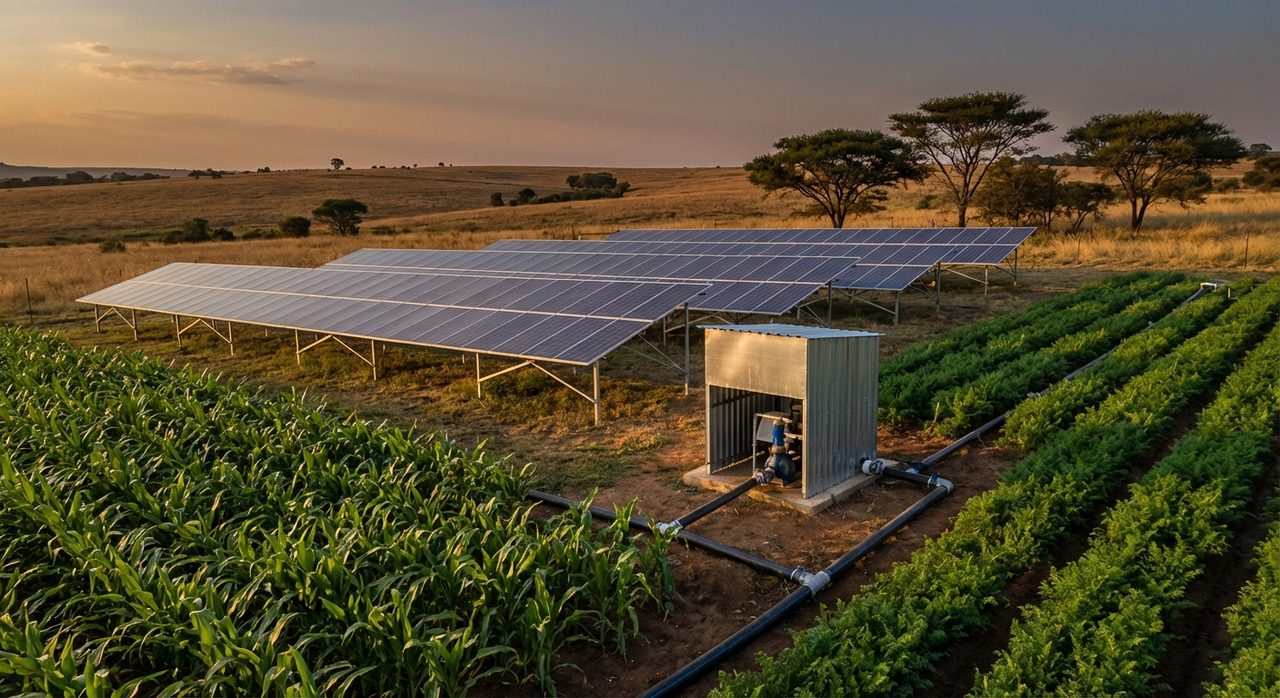
South African agriculture uses more electricity than almost any other sector. Irrigation pumping — whether from boreholes, rivers, dams, or bulk municipal supply — is typically the single largest electricity or diesel cost on any farm. And with Eskom's commercial agricultural tariffs consistently rising above 10% per year, the cost of pumping water is relentlessly eroding farm margins.
Solar-powered irrigation is one of the fastest-growing agricultural technology categories in South Africa. The natural alignment is near-perfect: crops need the most water when the sun is shining most intensely, meaning peak irrigation demand coincides exactly with peak solar generation. No batteries are needed for the most common irrigation designs. The water storage dam or tank acts as the energy store.
This guide covers everything South African farmers need to know about designing, sizing, and evaluating a solar irrigation system.
Why Solar Irrigation Makes Sense in South Africa
South Africa's agricultural conditions are uniquely suited to solar irrigation:
- Exceptional solar resource: Most agricultural areas receive 5–7 peak sun hours per day. The Northern Cape, Free State, and Limpopo are among the highest-irradiance agricultural regions in the world.
- Irrigation season aligns with solar peak: Summer crops in most SA regions are irrigated during the highest-irradiance months (October–March). Winter crops (Western Cape, some KwaZulu-Natal) may require storage consideration.
- Load shedding threatens existing electric pumps: A farm dependent on Eskom for irrigation faces crop loss risk during extended load shedding. Solar with a storage dam or tank is inherently resilient.
- Remote locations: Many South African farms are in areas with poor or no Eskom supply. Solar eliminates both the infrastructure cost of extending the grid and the ongoing diesel fuel cost of generator-driven pumps.
Solar Irrigation System Types
1. Direct Solar Pumping (No Batteries)
The most common and cost-effective design. Solar panels directly power a pump through a Variable Frequency Drive (VFD) or dedicated solar pump controller. The system pumps during daylight hours, filling a storage dam, reservoir, or elevated tank. Water is then distributed under gravity or via a separate smaller distribution pump.
Best suited for: Farms where pumping schedule flexibility exists (most irrigation applications), borehole recharge systems, dam filling, and livestock water supply.
Advantages: No battery cost, low maintenance, simple design, excellent ROI, scalable.
Limitations: Pumping only occurs during daylight. Storage infrastructure required. Not suitable for systems that must pump on demand at night.
2. Solar Pumping with Battery Backup
The solar array charges a battery bank, which powers the pump controller. Allows pumping at night or during cloudy periods. Used where a storage dam is not feasible or where demand control requires precise timing.
Best suited for: Nurseries with precise irrigation timing, smaller systems where tank installation is impractical, drip systems with pressure-sensitive crops.
Limitations: Battery adds 30–60% to system cost. Battery replacement every 8–12 years (LiFePO4) adds lifecycle cost. More complex system management.
3. Solar with Grid Backup (Hybrid)
A solar system tied to the existing Eskom/municipal supply, with the inverter managing priority: solar first, grid when solar insufficient. No batteries required in the most common design (the grid acts as the backup). Best for farms with good grid supply that want to reduce their electricity bill without abandoning grid reliability.
Best suited for: Established irrigated farms with reliable grid supply and high electricity bills, large commercial operations where down-time risk is unacceptable.
Sizing a Solar Irrigation System
Step 1: Define Your Water Requirement
Start with crop water demand in mm/day or litres/hectare/day for your crop type, soil, and climate zone. Your irrigation agronomist or the ARC (Agricultural Research Council) crop water models can provide this data. Convert to a daily volume: for example, 5mm/day over 50 hectares = 250,000 litres/day = 250 kilolitres/day.
Step 2: Determine Pumping Head
Total dynamic head (TDH) is the total resistance the pump must overcome:
- Static head: Vertical distance from water source to delivery point (e.g., 30m borehole depth + 15m elevation to storage dam = 45m static)
- Friction head: Pipe resistance, typically 10–20% of static head for well-designed systems
- Pressure head: Any additional delivery pressure required (drip emitter operating pressure, pivot pressure)
For a 45m static head with 10% friction, TDH ≈ 50m.
Step 3: Calculate Pump Power Requirement
Using the hydraulic power formula: Power (kW) = (Flow in m³/s × Head in metres × density × gravity) / pump efficiency
Simplified: Power (kW) ≈ (Flow in m³/hr × Head in m) / (367 × pump efficiency)
Example: 25 m³/hour (25,000 litres/hour) at 50m head, 65% pump efficiency:
Power = (25 × 50) / (367 × 0.65) = 1,250 / 238.6 = 5.24kW
Step 4: Size the Solar Array
Account for VFD/controller efficiency (~90-95%), cable losses (~2-3%), and soiling (2-5%). For the 5.24kW pump example with a total system efficiency of 85%:
Solar array = 5.24kW / 0.85 = ~6.2kWp solar array required
At 5 peak sun hours, this array generates ~31 kWh/day. With the pump running 5 hours/day at full power, daily water volume = 25 m³/hr × 5 hr = 125 m³ (125,000 litres). Scale the array for more daily pumping hours if required by increasing to a larger panel array.
Step 5: Design Water Storage
Storage volume should cover at minimum 1–2 days of peak demand to buffer for cloudy periods. For 250,000 litres/day requirement, a 500,000 litre (500kL) storage dam is a practical minimum. Agricultural storage dams in this size range are typically R100,000–R250,000 to construct, depending on soil conditions and lining requirements.
Borehole Considerations for Solar Pumping
Most South African farms with boreholes run single-phase or three-phase submersible electric pumps. Converting these to solar requires:
- Borehole yield test: The borehole must be able to sustain the required flow rate continuously over solar pumping hours. A borehole with a 5 m³/hour sustainable yield cannot be pumped at 10 m³/hour even with a larger solar system — the pump will cause excessive drawdown and eventually air-lock.
- Pump selection: Most existing submersible pumps can be retrofitted with a solar VFD controller. Alternatively, purpose-built solar submersible pumps (Grundfos SQFlex, Lorentz PS, Franklin SubDrive) are specifically designed for variable voltage/frequency input and are highly efficient at partial solar irradiance.
- Borehole protection: VFD controllers must be set with appropriate minimum frequency to protect the pump at low irradiance. Float switches and low-flow cutoffs prevent running the pump dry.
Centre Pivot and Large-Scale Irrigation Solar Integration
Centre pivots are typically powered by three-phase motors of 11–75kW or more. Solar integration at this scale requires:
- A large ground-mounted or shed-roof solar array (typically 30–150kWp per pivot)
- A three-phase solar VFD drive rated for the pivot motor
- Grid hybrid integration if the pivot must run on demand at any time of day
- Monitoring system to manage pivot start/stop times to coincide with available solar generation
Many Free State, Northern Cape, and Limpopo grain and maize farmers are moving to time-shifted irrigation — running pivots from 08:00–16:00 daily using solar generation, with a smaller overnight grid draw. This approach can reduce pivot electricity costs by 50–70%.
Cost and ROI for Agricultural Solar Irrigation
The financial case for solar irrigation depends on what energy source you are replacing:
Replacing Diesel Generator Pumping
Diesel is the highest-cost pump energy source. At R24–R26/litre (2026 pricing), a 10kW diesel generator consuming 2.5 litres/hour costs R60–R65 per hour to run. Running 8 hours per day, 180 days per year: R86,400–R93,600 per year in diesel fuel for one pump.
A 12kWp solar system to replace this pump costs approximately R180,000–R240,000 installed. Payback period: 2–3 years. After payback, diesel savings are pure profit — and that saving grows as diesel prices rise.
Replacing Eskom Grid-Powered Pumping
Agricultural tariffs vary, but Eskom's Ruraflex tariff (common for farms) has energy rates of approximately R1.80–R2.50/kWh in peak periods. A 10kW pump running 8 hours/day, 180 days/year consumes 14,400 kWh/year. At R2.00/kWh average: R28,800/year.
A 12kWp solar system at R200,000 installed, saving R28,800/year: payback period 6–7 years. But factoring 10% annual Eskom tariff escalation, the effective payback drops to approximately 4–5 years, with increasing annual savings thereafter.
New Installations (No Existing Grid or Infrastructure)
For farms in areas without Eskom supply, solar irrigation avoids the combined cost of grid extension (R200,000–R1,000,000+ per km depending on terrain) and ongoing diesel. In these cases, solar irrigation is often the only economically rational choice — it is simply cheaper than the alternatives from day one.
Grants and Incentives for Agricultural Solar in South Africa
Several programmes support agricultural solar adoption in South Africa:
- DAFF (Department of Agriculture, Land Reform and Rural Development): Various conditional grant programmes have historically supported water infrastructure on smallholder farms. Availability changes annually — consult your provincial agricultural extension officer.
- DBSA (Development Bank of Southern Africa): Green economy financing at concessional rates for qualifying agricultural projects, including renewable energy.
- Land Bank: Agri-Solar loan products specifically designed for farmers installing solar for agricultural use.
- Agri-SA and Agribusiness funds: Industry bodies and commodity funds (Grain SA, Citrus Growers Association) periodically offer technical assistance grants for solar feasibility studies and installations.
- Section 12B Tax Deduction: Qualifying solar generation assets can be deducted at 125% in the first year — this applies to agricultural solar systems used for trade, including pump systems.
Choosing a Solar Irrigation Installer
Agricultural solar irrigation sits at the intersection of solar PV, electrical engineering, and irrigation agronomy. Not all solar installers have agricultural pump experience. Look for:
- Experience with borehole pump systems and VFD drives specifically (not just rooftop solar)
- Ability to carry out a proper hydraulic calculation (not just a generic solar quote)
- Familiarity with your specific crop type and irrigation schedule requirements
- Reference projects from other farms in your region and similar scale
- Warranty and O&M support for the full pump and solar system
Many agricultural equipment dealers (pivot companies, irrigation suppliers) have developed solar irrigation capabilities or partnerships. These can be strong choices since they understand the irrigation side well and partner with qualified solar electrical contractors for the PV installation.
Conclusion
Solar irrigation is one of the highest-ROI agricultural investments available to South African farmers in 2026. The natural alignment between peak solar generation and peak irrigation demand, combined with South Africa's exceptional solar resource and rapidly rising diesel and electricity costs, creates a compelling investment case — often with payback periods of 2–5 years.
The key to a successful system is accurate hydraulic sizing (not just panel sizing), appropriate water storage design, and proper borehole yield assessment. A solar pump system that outpaces the borehole's sustainable yield, or a storage dam too small to buffer cloudy periods, will underperform regardless of panel quality.
Done right, a solar irrigation system is a 25-year asset that permanently removes energy cost uncertainty from one of the most variable input costs on your farm — and irrigates your crops with free energy for two decades after the system has paid for itself.