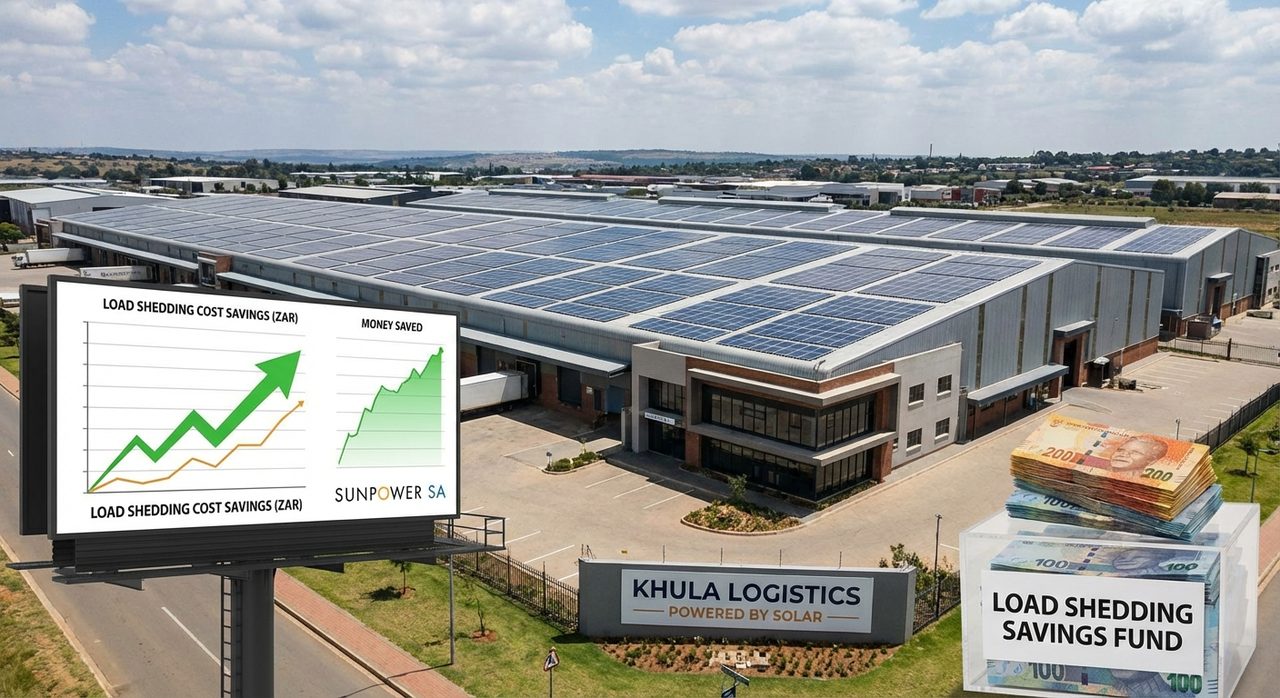
The True Cost of Load Shedding for South African Businesses
Ask a South African business owner what load shedding costs them and most will give you a vague answer: "a lot." Few have actually sat down to calculate it. The real figure is almost always higher than gut feel suggests — and when businesses complete the full accounting, the case for solar becomes undeniably compelling.
This article breaks down every category of cost that load shedding imposes on businesses, provides frameworks for calculating your specific exposure, and shows how a properly sized solar and battery system eliminates virtually all of it.
The Headline Numbers: What Load Shedding Costs South Africa
The South African Reserve Bank estimated in 2023 that every stage of load shedding costs the economy approximately R204 million per hour. At Stage 6, with 6,000 MW of deliberate load curtailment running for 12–16 hours per day, the daily economic cost exceeds R3.6 billion. Annualised, sustained high-stage load shedding represents a cost of more than R1 trillion to the South African economy — larger than the entire education budget.
For individual businesses, the costs are equally stark. A manufacturing SME with a R5 million monthly turnover losing 20% of productive hours to load shedding loses R1 million per month in revenue opportunity — more than R12 million per year.
Category 1: Direct Lost Revenue
The most obvious cost is revenue that cannot be generated during a power outage. This varies enormously by industry:
Retail and Hospitality
A retailer cannot process card payments, operate refrigerated displays, run lighting, or manage point-of-sale systems during load shedding. Customers leave and don't come back. Research by the South African Retail Council found that many small retailers lose 15–30% of daily revenue during a power cut, even when they have candles and a manual workaround for cash sales.
Restaurants and cafes face an even more acute problem: without refrigeration, ovens, and lighting, they simply cannot operate. A restaurant doing R80,000 per day in revenue loses R10,000–R20,000 during every 2-hour load shedding block, including the recovery period when staff reboot systems and rebuild kitchen momentum.
Manufacturing and Production
Production line downtime is expensive in ways that go beyond the immediate lost output. When a production line stops unexpectedly, work-in-progress (WIP) is often ruined. Restart procedures take time. Equipment that is stopped mid-cycle may require calibration before production can resume. Workers are paid during the downtime but produce nothing. Quality checks after restart consume additional time.
For a production facility with a R2 million monthly wage bill operating 200 hours per month, each hour of downtime costs R10,000 in wages alone — before factoring in lost output, WIP waste, and restart costs.
Professional Services and IT
Law firms, accounting practices, IT service providers, and call centres face a different but equally real problem. Laptop batteries keep staff working for a while, but server-dependent work stops when the server room goes down. Client calls are dropped. Deadlines are missed. The reputational and contractual consequences can be significant.
Category 2: Spoiled and Wasted Stock
For any business that stores perishable goods, load shedding is a direct threat to inventory. A chest freezer or commercial refrigerator maintains safe temperatures for approximately 4 hours without power — less if it's frequently opened. At Stage 6 load shedding running 12 hours per day in multiple blocks, the cumulative warming across the day can push products past safe temperature thresholds.
Food Service and Retail
A supermarket with R500,000 in refrigerated and frozen inventory faces existential risk during sustained high-stage load shedding. Even if no individual block exceeds 4 hours, cumulative temperature abuse across multiple daily blocks can cause spoilage that violates food safety standards and regulatory requirements.
Smaller establishments — restaurants, bottle stores, butcheries, fishmongers — have reported stock write-offs of R20,000–R100,000 during a single severe load shedding week.
Pharmaceutical and Healthcare
Pharmacies holding insulin, certain vaccines, and other temperature-sensitive medications face regulatory fines and liability exposure in addition to the cost of the product itself if cold chain integrity is breached. The compliance and liability dimension makes load shedding existentially serious for these businesses.
Category 3: Equipment Damage
Power surges when the grid restores — particularly the initial reconnection surge — damage sensitive electronic equipment. Computers, servers, PLCs (programmable logic controllers), VFDs (variable frequency drives), and sophisticated manufacturing equipment are all vulnerable. UPS systems provide some protection, but cheap UPS units do not filter surges adequately.
The pattern many businesses experience: the power comes back on and within minutes, a computer blows its power supply, a server crashes uncleanly losing data, or a motor controller trips on overvoltage. The cost of repairs and replacement parts — plus the downtime while waiting for them — accumulates rapidly.
A conservative estimate for equipment damage across South African businesses attributable to load shedding-related surges and improper power-down events runs into the hundreds of millions of rands annually.
Category 4: Generator Costs
Many businesses have responded to load shedding by installing diesel generators. While generators solve the immediate problem, they introduce their own substantial cost structure:
- Diesel fuel: A 30 kVA diesel generator consumes approximately 7–9 litres per hour. At R24/litre, that's R168–R216 per hour. Running for 6 hours per day during Stage 6, that's over R1,200/day in fuel alone — R36,000 per month.
- Maintenance: Diesel generators require oil changes every 200–250 hours, filter replacements, and periodic major overhauls. Annual maintenance costs for a business-grade generator typically run R20,000–R80,000.
- Depreciation: A quality 30 kVA generator costs R80,000–R150,000 and has a working life of 15,000–20,000 hours. At 6 hours per day, that's roughly 7–9 years — an annual depreciation cost of R10,000–R20,000.
- Noise and air quality: In urban environments, generator noise creates complaints and in some municipalities creates compliance obligations. Diesel exhaust in enclosed or semi-enclosed areas is a health and safety issue.
The total annual cost of generator operation for a medium business can easily exceed R500,000 — all of which a hybrid solar system makes unnecessary.
Category 5: Reputational and Relationship Costs
These are the hardest to quantify but may be the most damaging long-term.
Customer Churn
Customers who arrive at your premises to find you cannot serve them — because the power is out — don't necessarily come back. In a competitive market, a competitor who has backup power and can serve customers during load shedding gains a permanent advantage. Online reviews mentioning unreliable service due to power cuts damage reputation with potential customers who search before visiting.
Contractual Exposure
Many commercial contracts include SLA (service level agreement) penalties for downtime or missed deadlines. If load shedding causes you to breach an SLA, you may face contractual deductions or penalties. "Force majeure" clauses may or may not provide protection depending on how they are drafted and how courts interpret them.
Staff Morale and Retention
Working in a hot, dark office during load shedding is demoralising. For businesses in the war for talent — particularly in professional services and technology — the inability to guarantee a functional working environment contributes to employee dissatisfaction and attrition.
Calculating Your Business's Load Shedding Cost
To calculate your specific load shedding cost, work through this framework:
- Estimate annual load shedding hours: In a year with sustained Stage 4 load shedding, a business in a typical load shedding schedule might experience 1,500–2,000 hours of power cuts annually (averaging 4–6 hours per day).
- Calculate lost revenue: Divide your annual revenue by your annual operating hours. Multiply by the load shedding hours. This is your maximum potential lost revenue (actual may be lower if you have partial capability during outages).
- Add stock spoilage risk: Estimate the value of perishable stock at risk during an extended cut.
- Add generator operating costs: If you run a generator, sum fuel + maintenance + depreciation.
- Add equipment damage allowance: Based on your historical experience.
Most businesses that complete this exercise are surprised by the result. A business that thought load shedding cost it R300,000 per year often finds the true figure is closer to R800,000–R1.5 million when all categories are counted. Against a solar and battery investment of R700,000–R1.5 million, the payback calculation looks very different from a simple electricity bill analysis.
How Solar Eliminates Load Shedding Costs
A correctly sized hybrid solar system with battery storage eliminates virtually every load shedding cost category described above:
- Lost revenue: Eliminated. Your business operates normally throughout load shedding.
- Stock spoilage: Eliminated. Refrigeration and freezers run continuously on battery and solar power.
- Equipment damage: Largely eliminated. The inverter provides clean, regulated power regardless of grid quality.
- Generator costs: Eliminated or dramatically reduced to a backup-of-last-resort role.
- Reputational costs: Eliminated. You can serve customers and meet SLAs regardless of Eskom's schedule.
The solar system also reduces your electricity bill by 40–80%, provides a 125% Section 12B tax deduction, and increases your property value. When all these benefits are combined, the financial case for solar in South Africa is one of the strongest investment cases available to any business today.
Taking Action
If you haven't yet calculated your total load shedding cost, do it now. The number will motivate action. Then explore your solar options: start with our solar solutions overview, understand how to calculate your solar ROI, and look into financing options that let you go solar without a large upfront capital outlay.
The businesses that will thrive in South Africa's challenging energy environment are the ones that stop paying the load shedding tax and start generating their own clean, reliable power.